



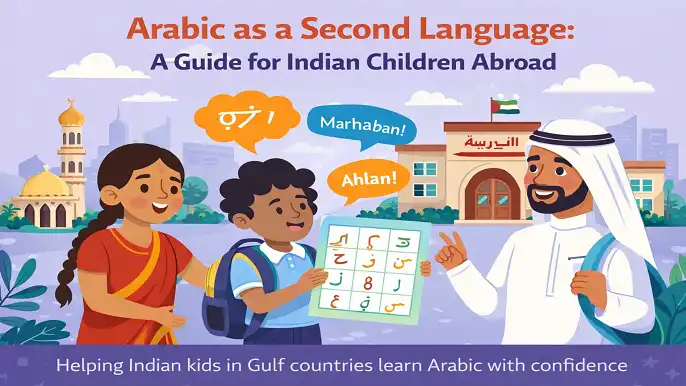
For many Indian families living abroad—especially in the Middle East—Arabic is not just another foreign language. It is the language of the country, the school environment, and everyday life. While children may grow up speaking English, Hindi, Malayalam, Tamil, or other Indian languages at home, Arabic often becomes an essential second language for academic success and social integration.
At Arabic Guru Academy, many Indian parents share similar concerns: When should children start learning Arabic? How difficult will it be? And how can parents support their child when Arabic is not spoken at home?
This guide addresses those questions and offers practical insight into helping Indian children learn Arabic as a second language with confidence.
For Indian expatriate families, especially in GCC countries, Arabic plays a significant role in a child’s education and daily life.
Arabic is important because:
Children who develop a strong foundation in Arabic early often find it easier to adapt socially and perform better academically.
For Indian children, Arabic is usually learned as a second or third language, after English and their mother tongue. This can feel challenging at first, especially because Arabic has a different script, sound system, and sentence structure.
Common challenges include:
However, children are naturally capable language learners. With the right approach, Arabic becomes far less intimidating and much more enjoyable.
There is no single “perfect” age, but early exposure offers clear advantages. Younger children tend to:
That said, older children can also succeed when learning Arabic—especially with structured guidance. What matters most is consistent instruction and a supportive learning environment, not the starting age alone.
Arabic can be taught in different ways, and choosing the right approach is especially important for Indian children learning it as a second language.
A strong learning plan usually includes:
At Arabic Guru Academy, lessons are designed to help non-native learners build Arabic step by step—without pressure or overload.
Indian parents often assume that fluency alone makes a good teacher. In reality, teaching children—especially second-language learners—requires specialized skills.
A child-focused Arabic tutor understands:
Children learn best when lessons feel safe, encouraging, and interactive. This is especially important for children balancing multiple languages.
One of the biggest worries Indian parents have is supporting Arabic learning when they don’t speak the language themselves. The good news is that parental support does not require Arabic fluency.
Parents can help by:
Simple encouragement goes a long way. When children feel that Arabic is valued at home, they are more motivated to learn.
Many Indian families abroad prefer online Arabic learning due to busy schedules and school commitments. When done correctly, online learning can be just as effective as in-person lessons.
Benefits of online Arabic learning include:
Arabic Guru Academy offers structured online lessons designed specifically for children learning Arabic as a second language.
Arabic learning is a journey, and progress should be measured realistically. Parents should look beyond test scores and focus on overall development.
Signs of healthy progress include:
A good Arabic program ensures steady improvement without overwhelming the child.
Indian children abroad often grow up multilingual. While this may seem challenging, it is actually a strength.
Learning Arabic alongside English and an Indian mother tongue:
With proper guidance, Arabic becomes a natural addition—not a burden.
Arabic, like any language, takes time to master. Indian parents are encouraged to focus on consistency rather than speed.
Short, regular lessons are more effective than:
Children who feel supported and unhurried develop a healthier and more lasting relationship with Arabic.
For Indian parents living abroad, helping children learn Arabic as a second language is both a responsibility and an opportunity. With the right approach, Arabic becomes more than a school subject—it becomes a bridge to culture, communication, and confidence.
At Arabic Guru Academy, the focus is on making Arabic accessible, engaging, and enjoyable for non-native learners. Through child-centered teaching, structured lessons, and strong parent-tutor communication, Indian children are supported every step of the way.
With patience, consistency, and the right guidance, Arabic can become a valuable and rewarding part of a child’s multilingual journey.