



A Deep, Human-Centered Exploration
For many people around the world, Arabic appears to be a language deeply intertwined with Islam — a language of scripture, prayer, and religious tradition. And while it is true that Arabic has profound spiritual significance for Muslims, the language itself extends far beyond the walls of any single faith community. It is, in its essence, a living, breathing language spoken by millions of people of all backgrounds — Christians, Jews, Druze, atheists, secular communities, and diverse cultures across more than 25 countries.
If anything, Arabic is one of the world’s most global languages. It is one of the six official languages of the United Nations. It is the native tongue of more than 400 million people — a population larger than that of the United States. It is a bridge language across Africa, the Middle East, the Gulf, and many parts of Asia. And increasingly, it is becoming a powerful tool for researchers, travelers, professionals, and global citizens.
For non-Muslims, learning Arabic often begins with a simple question:
“Is Arabic really for me?”
This article aims to answer that question deeply and honestly — not with clichés or shallow encouragement, but with a genuine exploration of why Arabic is a language for everyone, what it offers intellectually and culturally, and how modern platforms such as Arabic Guru Academy make it accessible to learners from every walk of life.
Languages do not belong to religions. They belong to people.
Arabic is a perfect example of this. It has evolved over centuries through empires, art, science, poetry, and global exchange. It lives in markets, in literature, in songs, in family conversations, in business meetings, and in the everyday lives of millions who have nothing to do with Islam.
Arabic is ranked among the top five most widely spoken languages in the world. It is also one of the fastest-growing languages online. This means that more websites, digital platforms, and businesses now operate in Arabic than ever before.
And here’s something many people don’t realize:
Arabic is considered a critical language by many Western governments — including the U.S., U.K., and European Union — because of its economic and geopolitical importance.
Learning Arabic is not simply about acquiring vocabulary and grammar. It is an invitation into:
In other words, Arabic opens a window into a world that is far more layered and human than the stereotypes dominating news cycles.
One of the most immediate benefits for non-Muslims learning Arabic is the way it transforms travel.
Someone who visits Morocco, Jordan, Egypt, Oman, Lebanon, or Tunisia with even basic Arabic phrases will often describe a completely different experience from those who rely on English alone.
Arabic-speaking societies value warmth and personal connection. A simple phrase like:
“Marhaban! Kayfa ḥāluk?”
(Hello! How are you?)
often softens interactions instantly.
Travelers frequently report surprising moments:
These moments happen not because of fluency, but because the visitor makes an effort — and Arabic speakers respond to effort with generosity.
Arabic helps travelers navigate:
It turns travel from tourism into genuine cultural immersion.
Professionally, Arabic is more than an asset — it is a differentiator. Few languages open as many doors across industries as Arabic does today.
From the Gulf’s booming tech sector to North Africa’s growing renewable energy market, Arabic-speaking regions are becoming central players in the global economy.
Companies prefer hiring professionals who understand Arabic because:
According to the British Council, Arabic is one of the top 10 most important languages for future economic competitiveness in the West.
Many international institutions — including the UN, UNICEF, WHO, and countless NGOs — rely heavily on Arabic-speaking staff. When field missions are deployed to the Middle East or North Africa, knowing Arabic becomes invaluable.
As Gulf countries invest heavily in AI, digital transformation, and research centers, professionals who understand Arabic gain access to:
The Modern Language Association reports that Arabic is one of the fastest-growing languages in university programs due to job demand and global significance.
Arabic is a gateway to one of the world’s richest scholarly traditions.
Between the 8th and 14th centuries, Arabic was the language of:
Researchers studying this era consistently emphasize that thousands of scientific manuscripts remain untranslated. Learning Arabic allows students to explore knowledge that shaped modern science — at its source.
Whether studying history, anthropology, linguistics, archaeology, or international law, students who know Arabic gain:
A study in the Journal of Near Eastern Studies found that Arabic manuscripts contain “critical historical and scientific insights” still underrepresented in Western academia.
Arabic challenges the brain in ways that build powerful cognitive abilities — especially for children.
Learning Arabic’s structure and script strengthens:
The brain becomes more adaptable when exposed to non-Latin writing systems.
A study published in Cognitive Development shows that learning a new writing system boosts visual processing skills. Arabic script — with its curves, dots, and connected letters — trains the brain differently than English does.
Young learners exposed to Arabic develop:
These skills are increasingly important in an interconnected world.
Perhaps the most exciting shift today is how technology has democratized language learning.
You no longer need to live in an Arabic-speaking country.
You no longer need to find a local tutor.
You no longer need expensive travel.
Online learning allows:
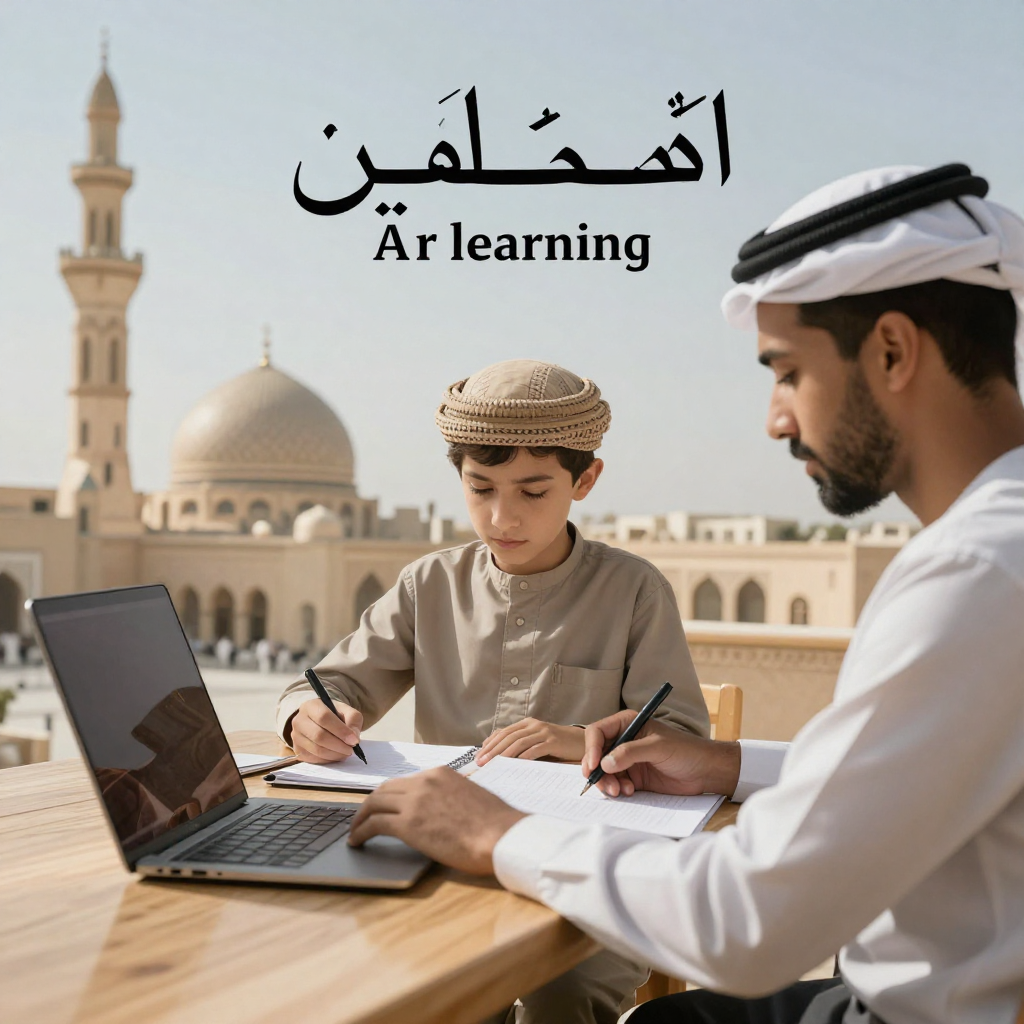
Platforms such as Arabic Guru Academy provide organized pathways for global learners — Muslims and non-Muslims — focusing on practical communication, cultural understanding, and foundational literacy.
These modern programs combine:
Many non-Muslim learners worry about entering a space dominated by religious elements.
But Arabic learning programs today — especially neutral, skill-centered ones — focus on language first, culture naturally, and religion only when culturally or linguistically relevant.
Not at all. Millions of native Arabic speakers belong to Christian, Jewish, and secular communities. Arabic simply happens to be the language of the Qur’an, but far predates Islam.
Every language seems difficult until the patterns start making sense.
Arabic is logical, structured, and phonetic — meaning once you learn the script, reading becomes surprisingly consistent.
There are dialects, yes, but Modern Standard Arabic (MSA) unites the entire Arab world in media, literature, academia, and formal communication.
You don’t need to jump into the deep end. Arabic rewards steady, thoughtful progress.
The alphabet is your foundation. Focus on:
Once mastered, everything becomes easier.
Begin with:
These create immediate usefulness.
Look for structured programs with global accessibility.
Platforms like Arabic Guru Academy provide beginner-friendly pathways designed for clarity, simplicity, and confidence-building.
Even basic conversation boosts motivation.
A single sentence spoken confidently can feel like a milestone.
Watch Arabic movies, listen to Arabic music, or follow Arabic social accounts.
Exposure builds intuition.
Arabic is not reserved for any single group of people. It is a global language woven into the histories, economies, and cultures of millions. For travelers, it opens doors. For professionals, it builds careers. For students, it unlocks knowledge. For young learners, it strengthens the brain. And for anyone seeking deeper global understanding, it offers a worldview rich with nuance, warmth, and humanity.
With the rise of online learning — from independent tutors to structured academies like Arabic Guru Academy — Arabic is more accessible than ever. No matter who you are, where you live, or what your background is, the Arabic language invites you to explore, understand, and connect.
Arabic is not just a language to learn.
It is a world to step into.